Living in Character: How Social Media Turned Everyday People Into Full-Time Performers

There's a story — probably apocryphal, but too good to ignore — about Dustin Hoffman showing up to the set of Marathon Man looking absolutely wrecked. He'd been awake for days, staying in character, living the physical and emotional reality of his role. Laurence Olivier, the legend goes, looked him over and said, "My dear boy, have you tried acting?"
The joke landed because method acting has always carried a whiff of the absurd. The idea that you have to become someone to convincingly portray them — that the performance only works if you lose yourself in it — has always seemed like a lot. But here's the uncomfortable thing: that's exactly what most of us are doing now, every single day, and nobody cast us in anything.
We are all method actors in our own lives. And a lot of us have no idea how to break character anymore.
The Stage Is Everywhere
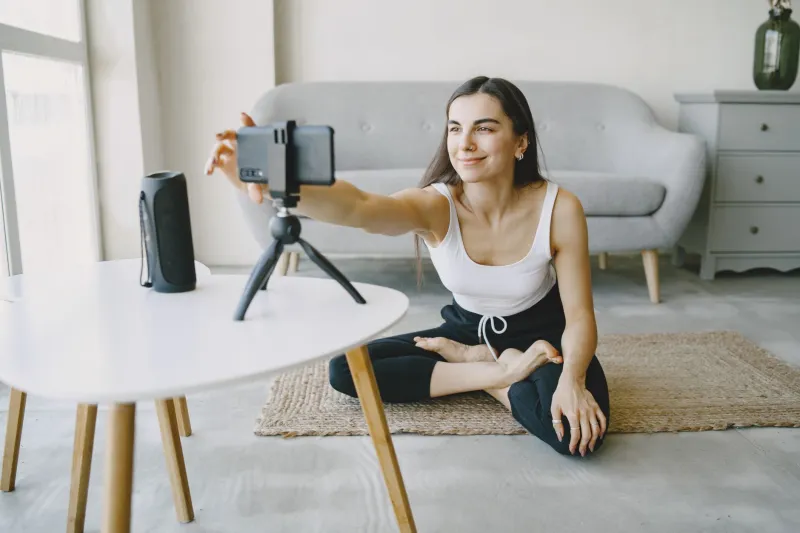
Let's be specific about what we're talking about. The average American adult now manages somewhere between three and seven active social media profiles. That's three to seven distinct stages, each with its own audience, its own unwritten rules, its own version of you that the algorithm has decided performs best.
Your LinkedIn self is polished, professionally hungry, dropping thought leadership like it's a full-time job. Your Instagram self is curated within an inch of its life — the right filter, the right caption energy, the right ratio of vulnerability to aspiration. Your TikTok self is looser, more "authentic" (more on that word in a second), but still hitting certain beats because you've watched enough videos to know what actually gets traction. And your group chat self? That's the one you think is the real you, until you notice you're still performing a little, still calibrating, still reading the room.
Psychologists call this kind of self-presentation management "impression management," a concept sociologist Erving Goffman laid out back in 1959 in The Presentation of Self in Everyday Life. Goffman argued that all social interaction is essentially theatrical — we're always playing roles. But Goffman was writing about a world where the stage had natural limits. You went home. The curtain dropped. Now the curtain never drops.
The Algorithm Writes Your Character
Here's where it gets genuinely strange. In traditional method acting, you choose the character. You study them, you inhabit them, you decide how they move and speak and react. You retain some directorial control, even when you're deep in the process.
Social media flips that dynamic entirely. You don't choose your algorithmic persona — you discover it, usually by accident, and then you start feeding it because the feedback loop is intoxicating. You post something offhand and it blows up. You post something you worked on for hours and it flatlines. Over time, you learn what version of yourself gets the response, and you start producing more of that version, whether or not it reflects anything true about who you actually are.
This is the attention span paradox in its purest form. We're not distracted despite ourselves — we're performing despite ourselves, and the performance is being co-written by an algorithm that has no interest in your psychological wellbeing, only in your engagement metrics.
Research out of the American Psychological Association has linked heavy social media use to increased rates of anxiety, depression, and something researchers are increasingly calling "identity diffusion" — a state where people struggle to maintain a stable, coherent sense of self across different contexts. That's not a bug. That's the business model working exactly as designed.
When the Role Eats the Actor
Method acting's most cautionary tales are the ones where the actor couldn't find the exit. Heath Ledger's preparation for the Joker. Jared Leto's infamous method spiral during Suicide Squad. Shia LaBeouf's years-long performance art that blurred into what seemed like a genuine identity crisis. These are extreme cases, but they point to something real: when you invest deeply enough in a persona, the persona starts investing back.
For regular people — not movie stars, just regular Americans trying to navigate their social feeds — the equivalent looks quieter but cuts just as deep. It's the person who realizes they've been posting a "grateful and grounded" version of themselves for so long that they can no longer access actual gratitude or groundedness without staging it first. It's the guy who built a whole "authentic blue-collar realness" brand online and now feels like a fraud at his own kitchen table. It's the woman who spent years performing wellness and productivity and woke up one morning completely hollowed out.
Therapists are seeing this in their practices. The language has shifted. Clients don't just talk about feeling stressed or sad — they talk about feeling like they're "playing themselves" wrong, like they've forgotten their lines, like they're not sure which version of themselves is the original.
The Authenticity Trap
The cruel irony is that the platform era sold us authenticity as the solution. "Just be yourself" was the rallying cry of every influencer coach, every personal branding guru, every TikTok creator who built an audience by supposedly dropping the mask. But authenticity became a genre. It got aestheticized, packaged, and sold back to us in the form of confessional posts, "raw" videos shot in cars, and carefully unfiltered moments that took three takes to get right.
"Being yourself" online is now one of the most sophisticated performances going. And we all know it, even if we don't say it out loud.
This doesn't mean everyone online is a cynical fraud. Most people genuinely want connection. They want to be seen. The tragedy is that the infrastructure we built for connection actively punishes honesty and rewards performance, so the desire for realness ends up producing more theater.
Finding the Exit
So what do you do with this? The easy answer — log off, touch grass, live your life — is genuinely good advice and also basically useless, because we've built careers, relationships, and entire social ecosystems inside these platforms. You can't just walk offstage.
But you can start noticing the performance. Therapists who work with social media-related identity issues often talk about the value of "platform detachment" — not quitting, but creating deliberate moments where you interact with the world without thinking about how it would play on your feed. A meal you don't photograph. A thought you don't tweet. A weekend that exists only for the people who were actually there.
It sounds small. It is small. But so is the gap between who you are and who your algorithm thinks you are — until it isn't.
Laurence Olivier's point to Dustin Hoffman wasn't that commitment is bad. It's that there's a difference between a great performance and losing yourself inside one. The best actors know where the character ends and they begin. The rest of us are still figuring that out, one post at a time.