Perfectly Imperfect: The Strange Business of Selling You Someone Else's Mess
Somewhere between the third "I woke up like this" Instagram Story and the fourteenth TikTok of someone crying in their car while a lo-fi beat plays softly in the background, you start to notice something. All of this chaos looks remarkably... coordinated.
The lighting is always soft. The mascara runs in a photogenic direction. The apartment in the background is messy in a way that still manages to hit every Pinterest trend from 2023. And the caption? Something like: just being real with you guys. Followed by a link to a skincare brand.
Welcome to the Authenticity Industrial Complex — a multibillion-dollar machine that has taken the raw, uncomfortable business of being a flawed human being and turned it into a highly optimized content category.
How "Real" Became a Product Line
It didn't happen overnight. The shift away from aspirational perfection — the glossy, unattainable Instagram of the early 2010s — was genuinely driven by audience fatigue. People got tired of feeling bad about themselves. Engagement started tanking on polished content. Creators who showed vulnerability, who admitted to struggling, who posted a photo without a filter — they blew up.
The platforms noticed. The brands noticed faster.
By the early 2020s, "relatability" wasn't just a personality trait. It was a content strategy, complete with coaching, workshops, and brand deals specifically structured around the performance of imperfection. Agencies started advising clients on how to be messy in a way that still moved product. Influencer briefs began including language like "authentic tone" and "raw, unfiltered feel" — language that was written by a marketing director in a glass-walled office in Manhattan.
The result is what we're living through now: an entire aesthetic ecosystem built around the performance of not performing.
The Messy Girl Era Has a Uniform
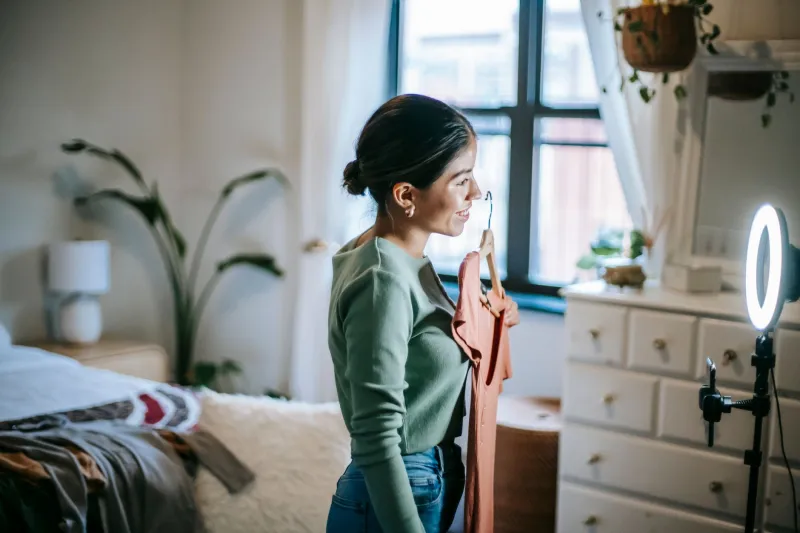
Let's talk about what "messy" actually looks like in the wild, because it's surprisingly consistent. There's the undone bun — not actually undone, but styled to appear that way, often with a specific clip that costs $34. There's the "no-makeup makeup" that takes longer to apply than a full face. There's the bedroom confessional video, always shot in the same low-angle, warm-toned aesthetic that communicates "I just grabbed my phone" but was almost certainly filmed with a ring light and a gimbal.
The language is just as standardized. "Not going to pretend everything is fine." "Raw and honest post incoming." "I'm in my [blank] era" — a phrase that has become so ubiquitous it now functions as its own kind of armor, a way of branding your emotional state before anyone else can define it for you.
None of this is accidental. Creators who work at scale — the ones with hundreds of thousands of followers — have teams. They have editors, brand managers, and sometimes dedicated "authenticity consultants" whose literal job is to make sure the vulnerability content hits the right notes without alienating sponsors. The mess is managed.
Brands Jumped In Immediately
If you want to understand how thoroughly this phenomenon has been commercialized, just look at how corporations have adopted the language of imperfection. Brands now post deliberately typo-riddled tweets. Fast food chains have entire social media presences built around being "unhinged" — a word that used to describe a mental health crisis and now describes a Wendy's post about chicken nuggets.
Dunkin', Duolingo, and a dozen other companies have leaned so hard into the "we're kind of a mess too" persona that it's become its own genre of corporate communication. And it works, at least for a while, because it mimics the register of the creators audiences already trust.
The problem is that it's a closed loop. The more brands adopt the aesthetics of authenticity, the more those aesthetics get associated with selling something, which means creators have to push further into "real" territory to stay ahead — which means more manufactured vulnerability, which means more brand deals attached to that vulnerability, which means the whole cycle tightens another notch.
The Paradox Nobody Wants to Name
Here's the uncomfortable truth at the center of all this: authenticity, by definition, cannot be a strategy. The moment you decide to "be authentic" as a deliberate choice — especially one tied to a revenue stream — you've already stepped outside of it.
This isn't a moral judgment. Most creators navigating this landscape are doing exactly what the economy demands of them. If the algorithm rewards vulnerability and brands pay for relatability, then producing both is just... work. Rational, professional work.
But it does create a strange cultural condition where the audience can never quite be sure what they're actually looking at. Is this person genuinely struggling, or is this a well-timed breakdown ahead of a product launch? Is that "messy apartment" a real reflection of someone's life, or a set? The answer, increasingly, is that it doesn't matter — because the content performs the same either way.
What Gets Lost in the Transaction
What actually suffers is the thing this whole ecosystem claimed to provide: genuine human connection. When everything is optimized for relatability, nothing is actually relatable. You can feel the seams. Audiences — especially younger ones — are getting sharper at detecting the gap between performed vulnerability and the real thing, and the cynicism that follows is profound.
There's also something quietly damaging about the standardization of emotional expression. When "being a mess" has a specific aesthetic, a specific vocabulary, and a specific product tie-in, it subtly communicates to people that their actual, unbranded, non-photogenic chaos doesn't quite count. That their real bad days — the ones without good lighting and a redemptive arc — are somehow doing it wrong.
The authenticity industrial complex doesn't just sell you a performance. It makes you feel like your genuine experience needs an upgrade.
So What's Actually Real?
Honest answer? It's harder to find than it used to be, and that's not entirely the creators' fault. The infrastructure of every major platform is built to reward content that performs well, and vulnerability performs extremely well. Until it gets oversaturated and the algorithm shifts again.
The moments that still feel real tend to be the ones that don't fit the template — the weird, specific, not-particularly-aesthetic ones that don't have a brand deal attached. They're rarer, and they tend to exist in smaller corners of the internet that haven't been fully colonized yet.
But give it a season. Someone will figure out how to monetize those too.
The machine is patient. And it's very, very good at making you feel like you found something genuine right before it sells you something.