Same Cover, Same Tropes, Same Blurb: How BookTok Taught Publishing to Stop Guessing
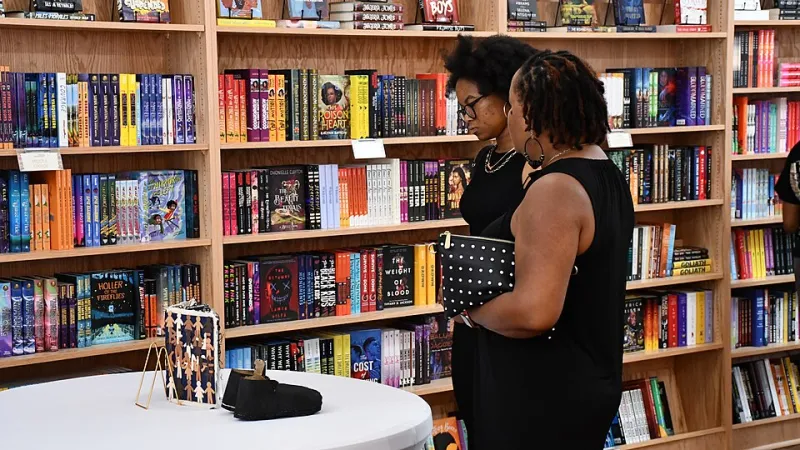
Photo: NPS, Public domain, via Wikimedia Commons
Walk into any large bookstore in America right now and you will see the same table. Pastel gradients. Illustrated figures, usually two of them, usually mid-glance. A title in a serif font with a colon in it. Three or four blurbs on the front, most of them from a creator whose name you recognize from a phone screen rather than a newspaper. And somewhere on the jacket, in slightly smaller type, the words 'the next BookTok sensation' — a phrase that has gone, in just a few years, from compliment to category to quiet warning label.
None of this happened by accident. Almost none of it happened because readers demanded it. It happened because recommendation culture got an algorithm, the algorithm developed a taste, and the taste got replicated by an industry that has never met a working formula it didn't want to run into the ground.
The Feed Rewards Legibility
BookTok is not a monolith, and the people making videos in it are not villains. But the mechanics of the feed reward a specific kind of book: one that can be summarized in four seconds, that slots into a trope label, and that produces a visible reaction someone can film.
Enemies to lovers. Fake dating. Only one bed. These tags are decades old — romance readers have been indexing books this way since before the internet had a bookstore. What changed is that the tags stopped being a way to find a book and became the pitch, then the brief, then the product itself.
A novel that resists a one-line hook doesn't die on BookTok. It just never appears there. And a book that never appears there increasingly doesn't get bought by a publisher in the first place.
Debut Authors Get a Brief Now
Talk to anyone who has sold a first novel in the last three years and the stories start rhyming. The agent asks what comps you're pitching. The editor asks whether the love interest could arrive sooner. Someone mentions, gently, that the ending is beautiful but the middle could use 'more of the thing that worked in the other one.' These are professionals doing their jobs in a market where discovery is concentrated in a handful of feeds, and where nobody wants to be the person who passed on the last phenomenon.
So the note becomes some version of: make it more like the thing that sold. Multiply it. Swap the names. Keep the cover. Readers who loved the last one will find it, and the algorithm will do the rest.
The result is a shelf where the difference between one book and the next is mostly the character names and the shade of the cover gradient. That is not a reader problem. That is a supply problem dressed up as demand.
Readers Are Not Confused. They Are Bored.
The part publishers consistently underestimate is that the audience can see the seams. Reviews are getting sharper and funnier about it — variations on 'I guessed the entire plot from the back cover' and 'this is the same book I read in March with a different map.' The people who made a book go viral are the same people who notice when they're being sold the same book twice.
And to be fair to the industry, the boom is not nothing. BookTok put money in independent bookstores, got teenagers reading for pleasure again, and turned a generation of creators into a genuine marketing force. Nobody sensible wants to go back to a world where the only people who knew about a debut novel were three reviewers and the author's mother.
But a boom built on one narrow template has a specific failure mode: the moment the feed gets bored, the shelf is left holding a warehouse full of books that were designed for a trend that already moved on.
What the Algorithm Cannot See
The algorithm can tell you what sold last quarter. It cannot tell you what's missing, because missing things produce no data. The books that don't fit the feed — the weird ones, the slow ones, the ones with an unlikeable narrator and no love interest at all — are exactly the books that will define what people are nostalgic for in ten years.
Some of those still find their way through. They usually arrive via a small press, or a bookseller who hand-sells the same twelve copies to twelve different people, or a creator who breaks the format deliberately because they're bored of it too.
The formula isn't the enemy. A formula has always been how genres work, and plenty of great books wear their tropes proudly. The problem is faith in the formula as a permanent strategy, in a medium whose entire history is a record of readers eventually demanding something they haven't already read.